
Specifying API 6D Ball Valves for Offshore SPM Pipelines & Sour Crude
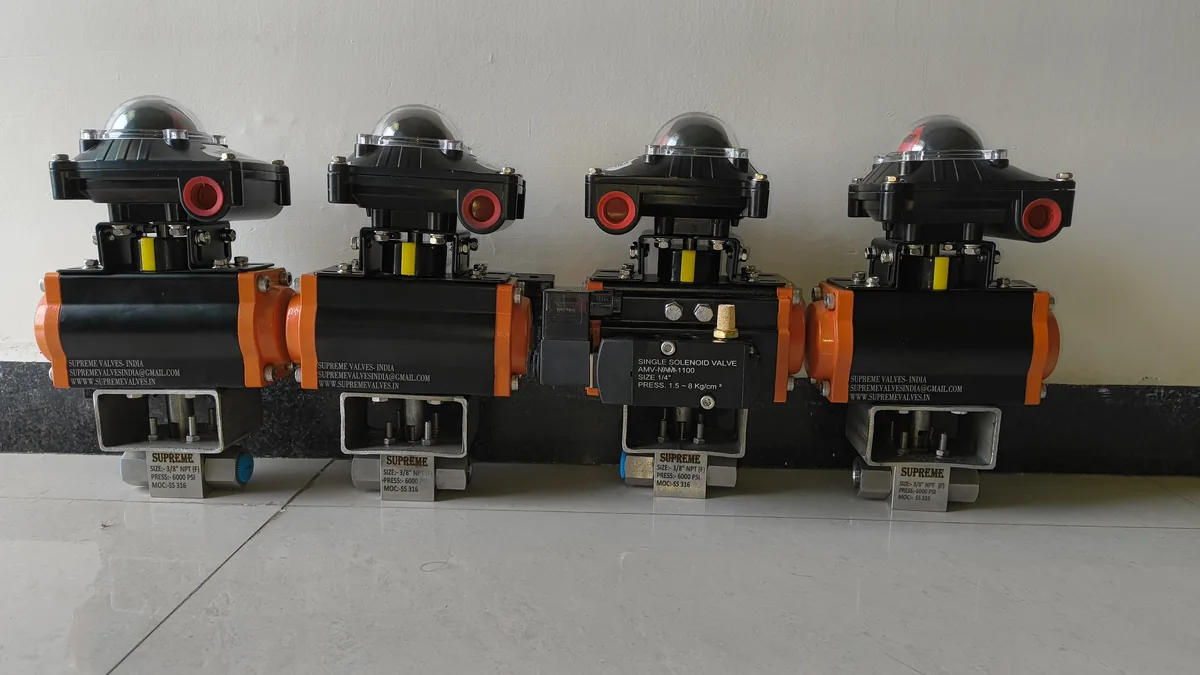
6000 PSI SS316 ball valve with pneumatic actuator, limit switch and 24V DC solenoid valve.
Offshore Single Point Mooring (SPM) facilities demand highly specialized valve engineering to handle the immense flow rates of crude oil offloading, the corrosive nature of sour service environments, and the strict safety mandates of EPCM contractors.
Table of Contents
1. The Role of Ball Valves in SPM Systems
A Single Point Mooring (SPM) system—also known as a CALM buoy—allows large crude carriers (VLCCs) to offload their cargo in deep water. The crude travels through subsea pipelines (typically 32" to 48" in diameter) to an onshore oil terminal.
The isolation valves used in these pipelines must be large-diameter API 6D Trunnion Mounted Ball Valves. Trunnion mounting ensures that the massive line pressure does not push the ball into the downstream seat (which would cause excessive operating torque), but rather absorbs the thrust through the trunnion bearings.
2. Material Selection for Sour Crude (H2S)
Crude oil often contains high levels of Hydrogen Sulfide (H2S), creating a "sour service" environment that causes Sulfide Stress Cracking (SSC) in standard steels. EPCM specifications dictate that all wetted parts must comply with NACE MR0175 / ISO 15156.
- Body Material: ASTM A105N (Forged Carbon Steel) is preferred over cast WCB to eliminate porosity and casting defects in high-pressure offshore applications.
- Trim Material: ASTM A182 F6A Cl.2 or Duplex Stainless Steel (ASTM A182 F51) for the ball and stem provides the necessary strength and localized corrosion resistance.
- Soft Seals: Elastomers must be Explosive Decompression (ED) resistant. FKM AED O-rings and Devlon/Nylon seat inserts are standard for high-pressure crude applications.
3. Alloy 625 (INC625) Weld Overlay
One of the most critical specifications in modern EPCM requirements for SPM pipelines is the application of Alloy 625 (Inconel 625) weld overlay.
Even when the valve body is carbon steel, all critical sealing areas—including the seat pockets and stem seal areas—must be overlaid with at least 3mm of Alloy 625. This prevents pitting and crevice corrosion underneath the dynamic seals, ensuring zero leakage over a 25-year design life.
4. Vacuum Resistance & Corrosion Allowances
SPM unloading operations involve massive pumps transferring crude from the vessel to onshore tanks. If a pump pulls against a closed valve, or if line surge occurs, severe vacuum conditions can develop. Top-tier specifications mandate that valves must withstand a sustained internal vacuum of at least 1 milli-bar in both the fully open and fully closed positions without drawing in external air or damaging the seat seals.
Additionally, for a standard 25-year design life, EPCM contractors generally specify a minimum 3 mm corrosion allowance on the carbon steel body thickness, above and beyond the ASME B16.34 minimum wall requirements.
5. Actuation Sizing & Operational Torque
For Motor Operated Valves (MOVs) in critical offshore service, the actuator cannot just barely turn the valve. Specifications require that the actuator's rated torque output shall be 1.25 times the break torque required to operate the ball valve under the maximum differential pressure corresponding to the valve's ANSI class rating. This 25% safety factor ensures that even if the valve sits inactive for months and experiences increased "breakaway" stiction, the actuator will successfully isolate the line in an emergency.
6. Full Bore Design and Piggability
SPM pipelines require regular cleaning and inspection using intelligent "pigs". The API 6D ball valves must be 100% Full Bore (FB) to allow unobstructed passage. Furthermore, the internal cavity of the valve must be designed to minimize debris accumulation, and seats must remain fully protected when the valve is in the open position to prevent damage from the passing pig.
7. NDT, Testing, and FAT Requirements
EPCM contractors enforce rigorous quality assurance for offshore pipeline valves:
| Test / Inspection | Requirement |
|---|---|
| Non-Destructive Testing (NDT) | 100% RT on welds, UT on all forgings per ASME B16.34 / API 6D. |
| Hydrostatic & Air Seat Tests | Zero leakage requirement (Rate A). DBB (Double Block and Bleed) capability verified. |
| Operational Torque Test | Tested under full hydraulic pressure equal to maximum differential pressure. |
| Integrated FAT | Actuators (MOVs) tested at the manufacturer's facility under maximum differential pressure for at least 5 Open-Close-Open cycles to verify operating times. |
| Fire Safe Certification | Tested and certified to API 607, API 6FA, or BS EN ISO 10497. |
Need API 6D Valves for your Pipeline Project?
Supreme Valves India manufactures and supplies fully compliant API 6D Trunnion Mounted Ball Valves for EPCM and offshore projects globally.
View Product Specifications Request a Quote