
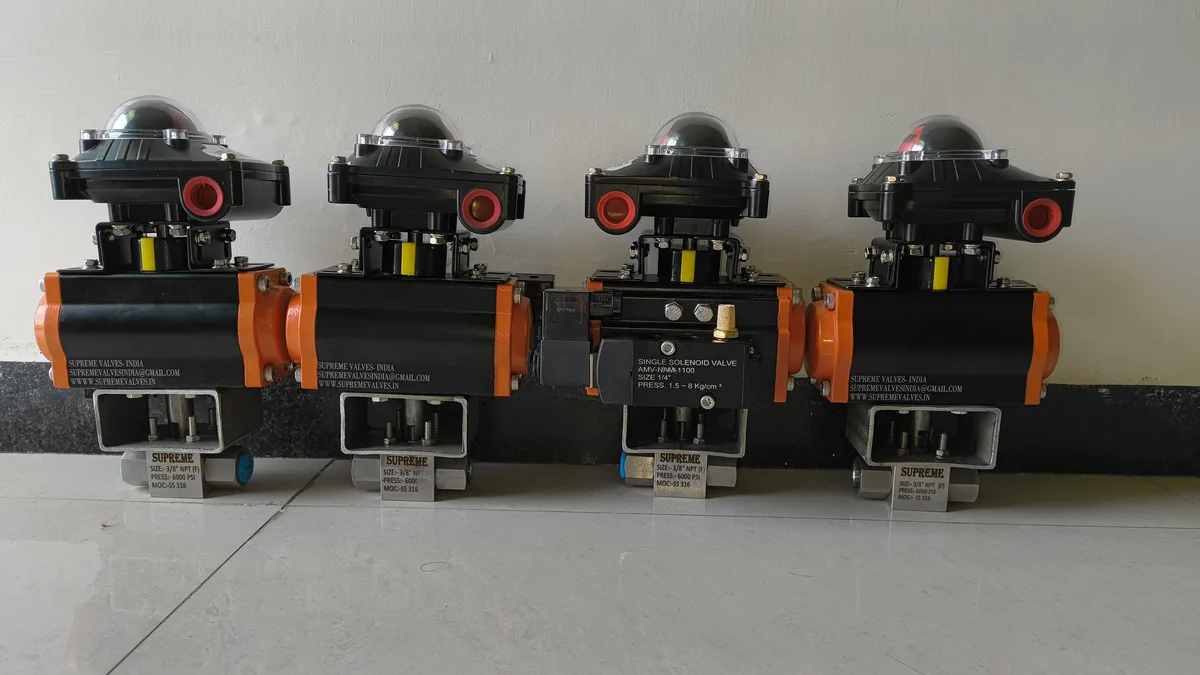
What is a 3-way pneumatic ball valve and when is it used?
A 3-way pneumatic ball valve has three ports (inlet, outlet A, outlet B) that control flow direction using a rotating ball. L-port valves route flow at 90 degrees and are used for alternating between two circuits or mixing two inlet streams into one outlet. T-port valves allow multi-directional flow paths. These valves are commonly used in batching systems, manifold switching, process sampling, and dual-tank filling/emptying operations in chemical, food processing, and pharmaceutical plants.
What is the difference between L-port and T-port 3-way ball valves?
L-port (90-degree) valves create a single flow path at 90 degrees from the inlet - ideal for switching between two circuits or simple on/off directional control. T-port valves have three opening angles and can connect multiple ports simultaneously, enabling complex flow patterns like mixing, diverting, or bypassing. L-port valves are simpler and lower cost; T-port valves offer greater flexibility for multi-circuit systems. Select based on your flow diagram requirements.
What materials are used for 3-way ball valve bodies in chemical service?
For chemical service, the most common body material is SS316 (ASTM A351 CF8M) for its excellent corrosion resistance. For aggressive media, Hastelloy C or Monel bodies are available. Seat materials range from PTFE (standard, up to 180 deg C) to PEEK (up to 250 deg C) for higher temperature or abrasive service. For steam service, graphite-filled PTFE or metal seats are used. Always match seat material to your process media and temperature.
How do I size a pneumatic actuator for a 3-way ball valve?
Actuator sizing for 3-way valves follows the same principles as standard ball valves. The critical torque is the breakaway torque to move the ball from fully closed to the first open position. For L-port valves, this is typically 1.5-2x the torque of a standard 2-way valve of the same size due to the ball port geometry. Select an actuator providing 1.3-1.5x the breakaway torque at minimum air supply pressure. Contact our engineering team for specific torque tables for your valve size and pressure class.
What are common applications for pneumatic 3-way ball valves in India?
In India, pneumatic 3-way ball valves are widely used in: chemical processing plants in Gujarat and Maharashtra; textile dyeing and finishing equipment; dairy and beverage processing ( CIP/SIP systems); pharmaceutical manufacturing (reactor charging/discharging); water treatment and desalination plants; paint and coating booths; and industrial laundry systems. The Ahmedabad and Vatva industrial zones are major users of these valves for process switching applications.