
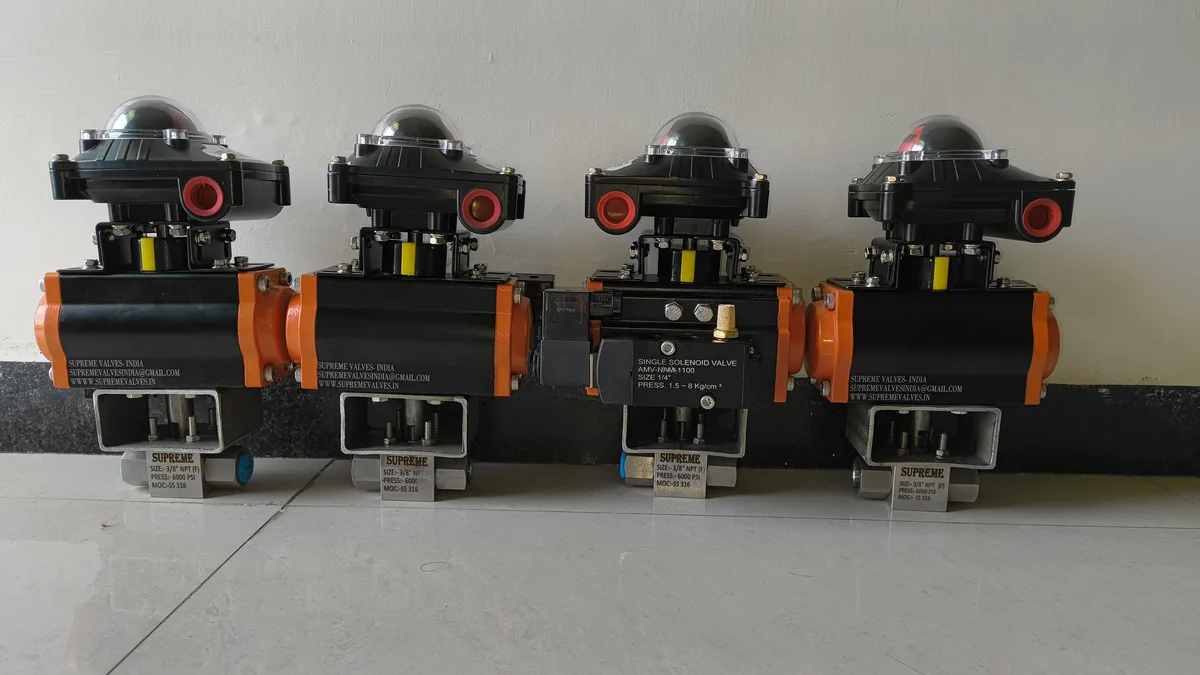
Spring Return Pneumatic Actuator - Supreme Valves India
4.8/5 (82 reviews) ISO 5211 India Made
Pneumatic Components

Spring Return Pneumatic Actuator | Fail-Safe Actuators

Spring return (single acting) pneumatic actuators for fail-safe valve operation. Air opens, spring closes. ISO 5211 mounting. ATEX options. For fire protection and safety-critical applications.

Key Specifications

Category: Pneumatic Components
Brand: Supreme Valves India
Origin: Ahmedabad, Gujarat
Certification: ISO 9001:2015

In-stock: Standard sizes ship within 3-5 working days from Ahmedabad. Export packaging available.

Request Enquiry WhatsApp Download Datasheet

Materials of Construction (MOC)

Component Material Specification
Body & Bonnet Ductile Iron (ASTM A536 / EN-GJS-400-15)
Stem / Spindle SS 410 / SS 420
Seat / Trim EPDM / NBR / Bronze

Technical Specifications

Parameter Specification / Standard
Manufacturing / Design Standard EN 1171 / AWWA C509 / BS 5163
Testing Standard API 598 / EN 12266-1
Pressure Rating PN16 / PN25

Frequently Asked Questions

What is a spring return pneumatic actuator?

A spring return actuator uses compressed air to move the piston in one direction (typically to open the valve) and a built-in spring to return the piston to the closed position when air pressure is removed. This makes them fail-safe - if air supply is lost, the valve automatically closes under spring force. Spring return actuators are required by code in many safety-critical applications: fire protection systems (FM/UL approved sprinkler valves), process plant emergency shutdown (ESD) valves, and anywhere the valve must close on loss of instrument air.

Why choose spring return over double acting actuators?

Spring return actuators are selected when fail-safe operation is required: the valve must close automatically on air failure, power failure, or emergency shutdown. Common applications: fire protection valves (UL/FM listed assemblies require fail-safe), batch process valves (material in pipeline must be isolated during upset), tank farm isolation (must close on gas detection), and any application where a failed-open valve could cause environmental, safety, or quality incidents. If fail-safe is not required, double acting actuators are preferred as they provide full torque in both directions at lower cost.

What happens to spring return actuator torque at different air pressures?

Spring return actuator torque varies significantly with air pressure: spring torque is maximum when fully extended (at air OFF) and minimum when fully compressed (at full air pressure). Air-assisted torque is minimum when fully extended and maximum when fully compressed. The critical calculation is the net closing torque at minimum air pressure. As air pressure decreases, the air-assisted opening force decreases while the spring closing force increases. Always verify the net closing torque at the minimum guaranteed air supply pressure - never size based on nominal pressure alone.

What is the difference between spring-start and spring-end spring return actuators?

Spring-start actuators have the spring pre-compressed in the air-open position - when air is lost, the spring extends to close the valve (spring-end). Spring-end actuators are the opposite - the spring is pre-loaded in the closed position and assists opening, with air pressure needed to close. Spring-end is more common in Europe and standard for FM/UL fire protection valve assemblies. Always specify the fail-safe position required by your application and codes.

Can spring return actuators be used for modulating control?

Spring return actuators are generally not recommended for modulating/throttling service because the spring force varies continuously with position, creating non-linear response and potential hunting. For modulating applications, use double-acting actuators with a positioner. However, spring return actuators can handle simple step-control (e.g., 3-position: open/close/throttle) if the cycling frequency is low and the actuator is properly sized with a safety factor of 1.5x minimum.