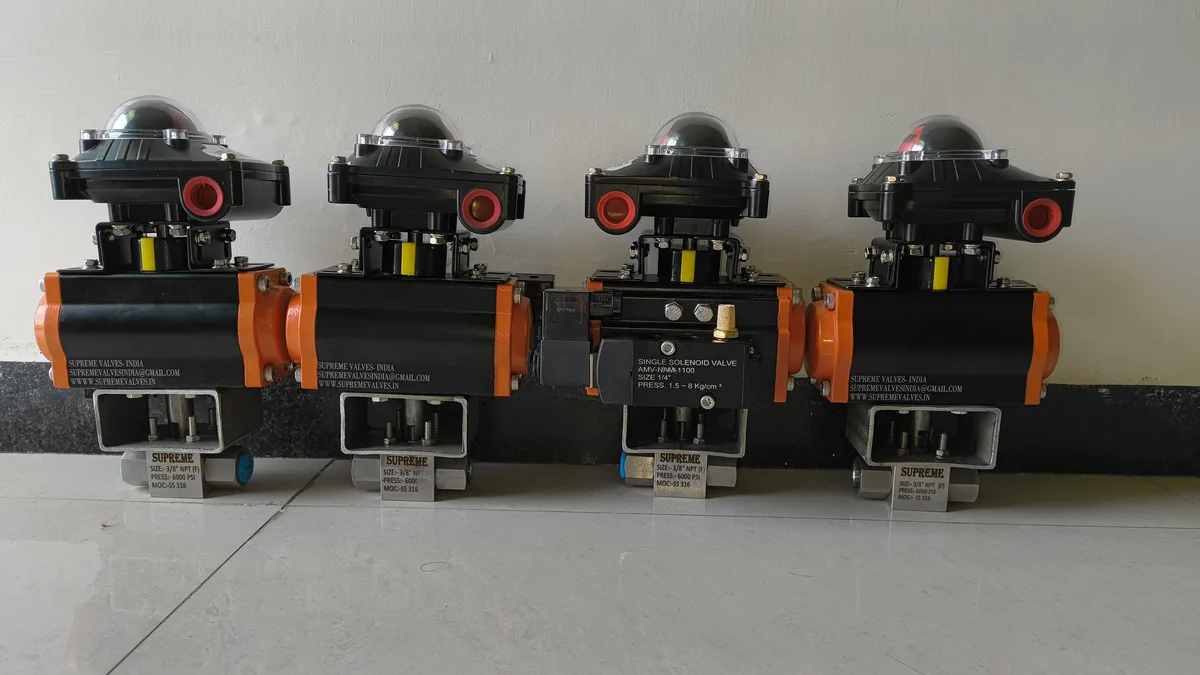
Pneumatic Butterfly Valve Wafer Type - Supreme Valves India
4.8/5 (82 reviews) ISO 5211 India Made
Pneumatic Valves

Pneumatic Wafer Butterfly Valve | Lug & Wafer Type

Pneumatic wafer butterfly valve for on/off and throttling service. Cast iron/ductile iron body, EPDM/PTFE liner. Sizes 2-inch to 24-inch. ISO 5211 actuator mounting.

Key Specifications

Category: Pneumatic Valves
Brand: Supreme Valves India
Origin: Ahmedabad, Gujarat
Certification: ISO 9001:2015

In-stock: Standard sizes ship within 3-5 working days from Ahmedabad. Export packaging available.

Request Enquiry WhatsApp Download Datasheet

Materials of Construction (MOC)

Component Material Specification
Body & Bonnet Ductile Iron (ASTM A536 / EN-GJS-400-15)
Stem / Spindle SS 410 / SS 420
Seat / Trim EPDM / NBR / Bronze

Technical Specifications

Parameter Specification / Standard
Manufacturing / Design Standard EN 1171 / AWWA C509 / BS 5163
Testing Standard API 598 / EN 12266-1
Pressure Rating PN16 / PN25

Material of Construction

S.N.Parts NameMaterial
01BODYWCB ,CF8 ,CF8M
02DISCWCB ,CF8 ,CF8M
03MOULDED SEATEPDM , PTFE , NBR , VITON
04STEMAISI 410 , AISI 316 , AISI 304
05LEVERM.S , S.S

Testing Details & Standards

  • Class: 150#
  • Hydro Test Pressure Body: 30
  • Hydro Test Pressure Seat: 22
  • Air Test Seat: 7

Dimension Tables

InchMMAØDH1H2ØEØMNPCD
1.1/2"40408054.0120.04015.9498.5
2"50439568.0130.05019.14120.5
2.1/2"654610877.0138.06519.14140.0
3"804612484.0157.08019.14152.4
4"10052150105.0170.010019.18190.5
5"12556186120.0186.012522.28216.0
6"15056205135.0200.015022.28241.0
8"20060258183.0237.020022.28298.4
10"25068321223.0286.025025.412362.0
12"30078368255.0314.030025.412431.8
14"35078438280.0340.035028.612476.2
16"400102490310.0378.040028.616539.8
18"450114602350.0400.045031.816577.8
20"500127700380.0440.050031.820635.0
24"600154695448.0510.060034.920749.3

Frequently Asked Questions

What is the difference between wafer and lug-type pneumatic butterfly valves?

Wafer valves are held between pipeline flanges by bolts that pass through the valve body - they cannot stand alone and require flanges on both sides. Lug valves have threaded inserts on the body that allow them to be bolted to a single flange and stand alone in the pipeline (useful for dead-end service). For general on/off service with flow in both directions, wafer valves are more cost-effective. For applications requiring the valve to seal one end of the pipe (tank isolation, dead-end service), lug valves are mandatory.

What is the pressure rating of pneumatic wafer butterfly valves?

Standard wafer butterfly valves are rated ASME Class 150 (PN10/PN16 depending on size), suitable for working pressures up to 285 PSI at ambient temperature. Larger valves (above 12-inch) may be rated lower. For higher pressures, special designs or double-flanged valves are required. Always check the pressure-temperature rating chart for your specific liner material - EPDM ratings decrease significantly above 120 deg C.

Can pneumatic butterfly valves be used for throttling (partial opening)?

Yes, pneumatic butterfly valves can be used for throttling, but with caveats. The flow characteristic of a butterfly valve is generally quick-opening, meaning a small stem rotation produces a large change in flow. For precise throttling, consider: selecting a charactered disc (offset disc design) for improved controllability; using a positioner on the pneumatic actuator for precise setpoint control; and ensuring the valve is sized so the operating point is in the 30-70% open range where control is best. For critical throttling, a globe valve may be a better choice.

What liner material should I select for my butterfly valve?

Liner selection depends on media and temperature: EPDM (Ethylene Propylene) is best for water, dilute acids/alkalis, and food service - not compatible with petroleum oils. NBR (Nitrile) is designed for petroleum products, hydraulic oils, and fuel service - not for ketones or esters. PTFE is chemically inert for aggressive acids/alkalis but has lower pressure ratings and higher cost. Always verify chemical compatibility with the liner material before ordering.

How do pneumatic butterfly valves compare to pneumatic ball valves?

Butterfly valves are generally lower cost and lighter weight than ball valves, especially in sizes above 6-inch. Butterfly valves require less torque to operate at high pressure because the disc rotates through the flow path (not against it), making them more efficient. However, ball valves provide tighter shut-off (bubble-tight vs. slight seepage for butterfly) and are better for on/off service. Butterfly valves are preferred for large water lines, HVAC, and throttling; ball valves for process shut-off and critical service.