Scotch Yoke Spring Return Actuator - Supreme Valves India
4.8/5 (82 reviews) ISO 5211 India Made
Pneumatic Components

Scotch Yoke Spring Return Actuator | Heavy Duty

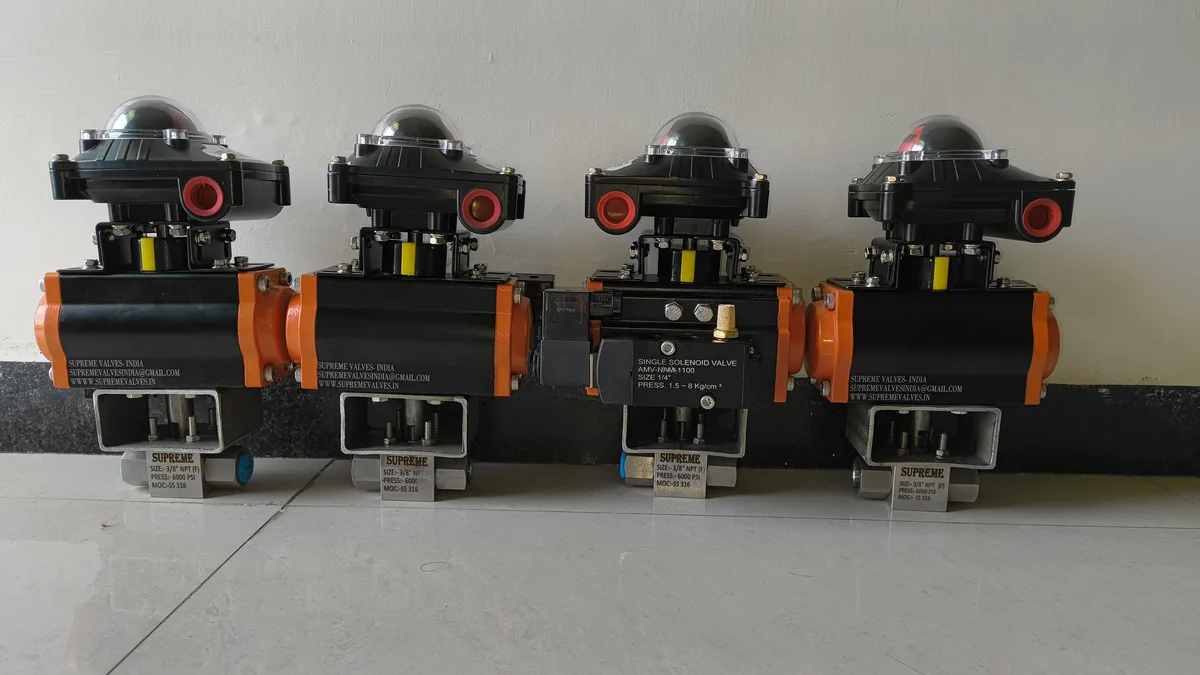
Scotch yoke spring return pneumatic actuators. Higher breakaway torque than rack and pinion. For gate valves, large butterfly valves. ISO 5211 and API 618 options. Heavy duty industrial use.

Key Specifications

Category: Pneumatic Components
Brand: Supreme Valves India
Origin: Ahmedabad, Gujarat
Certification: ISO 9001:2015

In-stock: Standard sizes ship within 3-5 working days from Ahmedabad. Export packaging available.

Request Enquiry WhatsApp Download Datasheet

Materials of Construction (MOC)

Component Material Specification
Body & Bonnet Ductile Iron (ASTM A536 / EN-GJS-400-15)
Stem / Spindle SS 410 / SS 420
Seat / Trim EPDM / NBR / Bronze

Technical Specifications

Parameter Specification / Standard
Manufacturing / Design Standard EN 1171 / AWWA C509 / BS 5163
Testing Standard API 598 / EN 12266-1
Pressure Rating PN16 / PN25

Frequently Asked Questions

What is a scotch yoke actuator and when is it used?

A scotch yoke actuator uses a sliding block that moves within a curved yoke to convert linear piston motion into rotational output. The key characteristic of scotch yoke is high breakaway torque at the beginning of the stroke (when the valve seat is tightest) - the mechanism naturally provides more force at the closed position. This makes scotch yoke actuators ideal for gate valves and other rotary valves requiring high initial breakaway torque. Compared to rack and pinion, scotch yoke actuators are larger, heavier, and more expensive but provide superior torque characteristics for heavy valve applications.

What is the difference between scotch yoke and rack and pinion actuators?

Rack and pinion actuators provide constant torque across the stroke (force on piston is perpendicular to rotation arm at all points). Scotch yoke actuators produce higher torque at the beginning of the stroke and lower torque at the end - better suited for gate valves which require maximum torque at seating/breakaway. For ball valves and butterfly valves (where seating torque is lower than running torque), rack and pinion is preferred. For gate valves and through-conduit valves, scotch yoke is preferred. Rack and pinion is more efficient (less air consumption per unit torque), more compact, and lower cost.

What is API 618 for scotch yoke actuators?

API 618 is the American Petroleum Institute standard specifically for pneumatic actuators for severe service butterfly and gate valves in hydrocarbon processing. It covers design, materials, testing, and documentation requirements for actuators used in petroleum, petrochemical, and gas industry applications. API 618 actuators must meet strict requirements for: material traceability; nondestructive testing; torque and pressure testing; and documentation including performance curves. For Middle East and international oil & gas projects, API 618 specification is frequently called out in valve procurement packages.